

Policy check
What a regulation now asks of you, with the clauses cited.
One ask to start with
“What changed in the EU AI Act obligations that apply in 2026?”
Text & code
Decision models
Tools
Model vs model
Gateways
Documentation
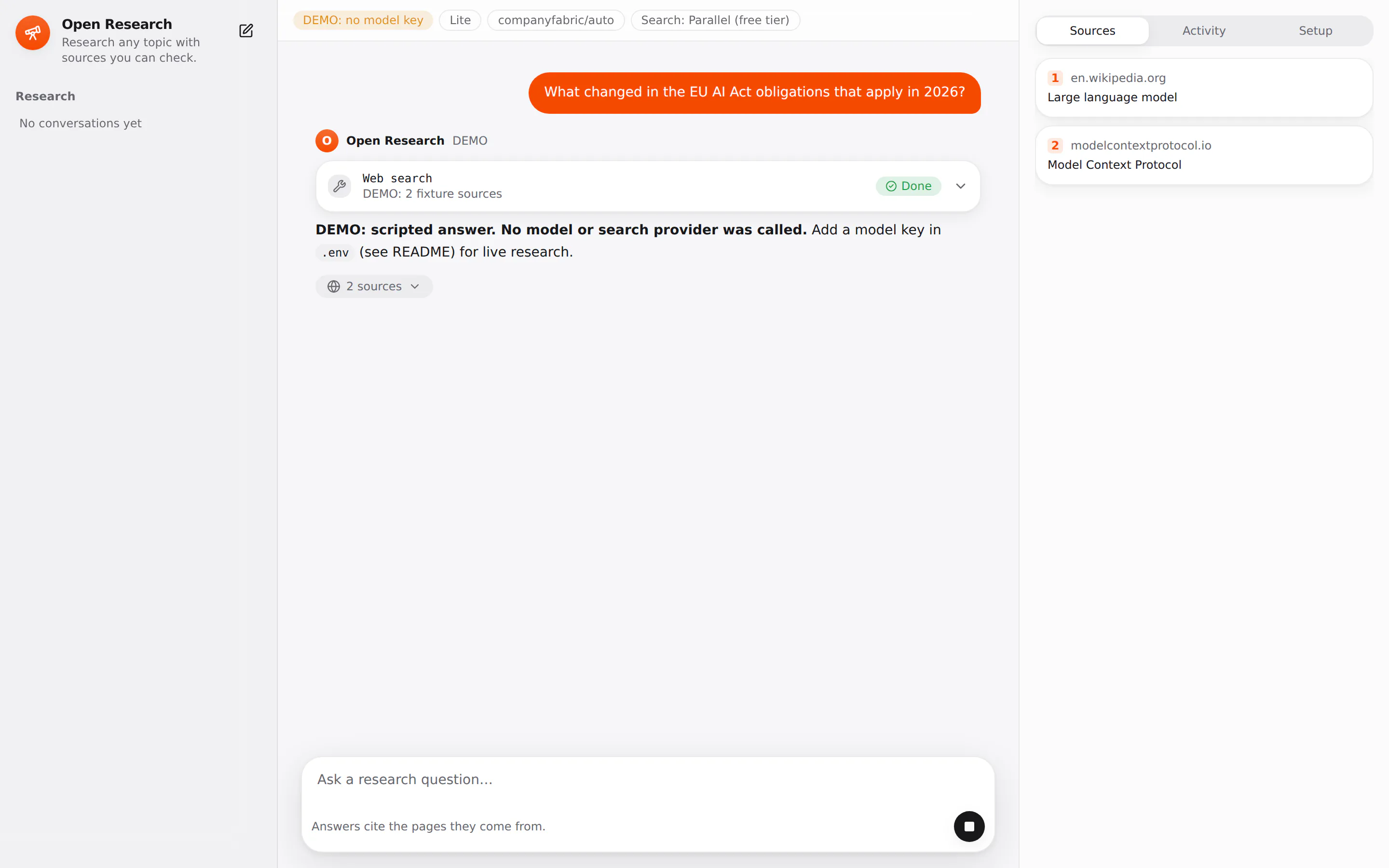
It plans searches, reads the most relevant pages and cites every claim with a numbered source.
How it works
How do AI research agents use tools?
01
Type it the way you would ask a colleague.
Web search: How do AI research agents use tools?
02
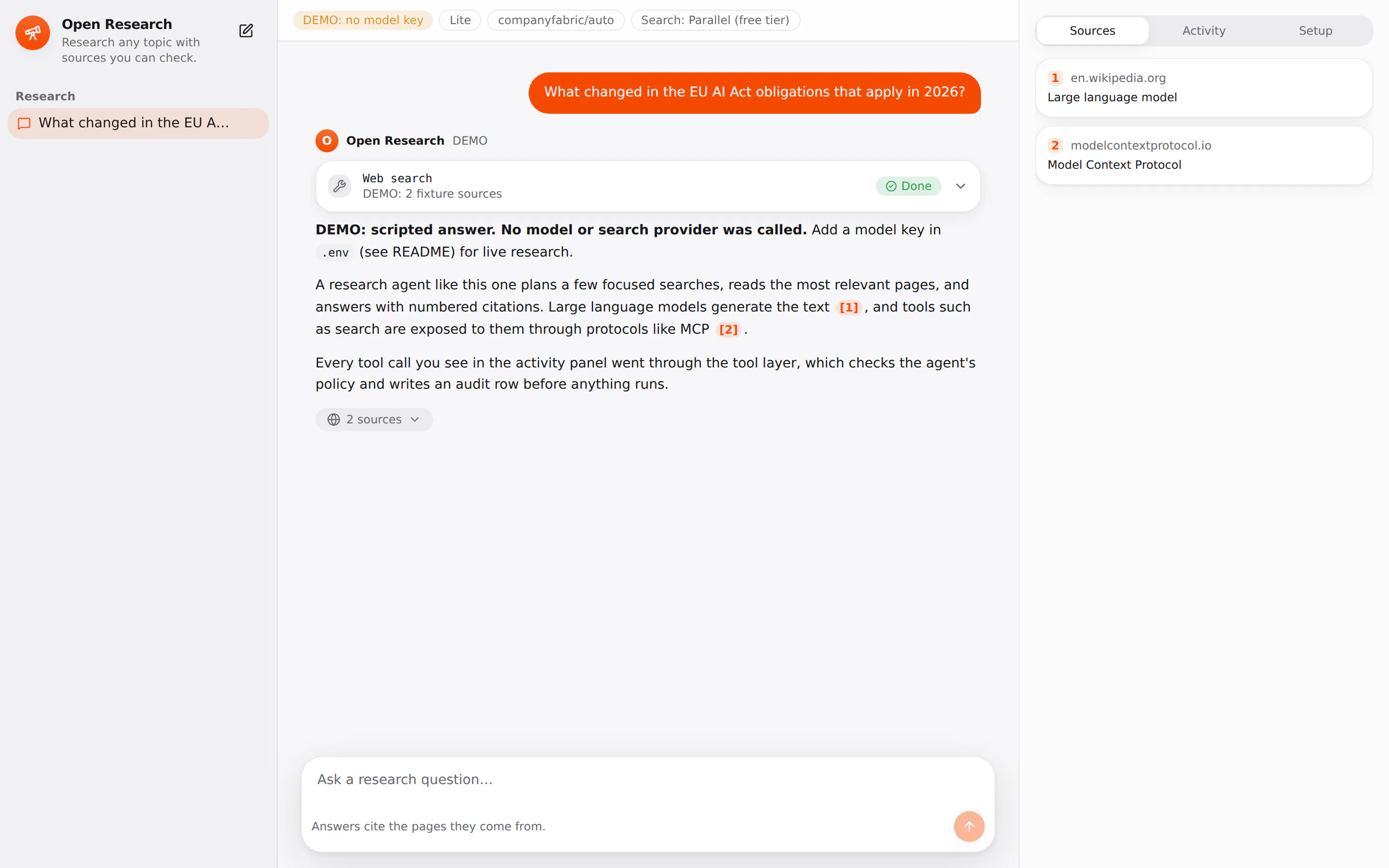
It plans focused searches and reads the most relevant pages.
Large language models generate the text 1, and tools such as search are exposed to them through protocols like MCP 2.
03
Every [n] points at a source a tool actually returned.
Sample data Scenes use the starter's built-in demo data.
Approvals
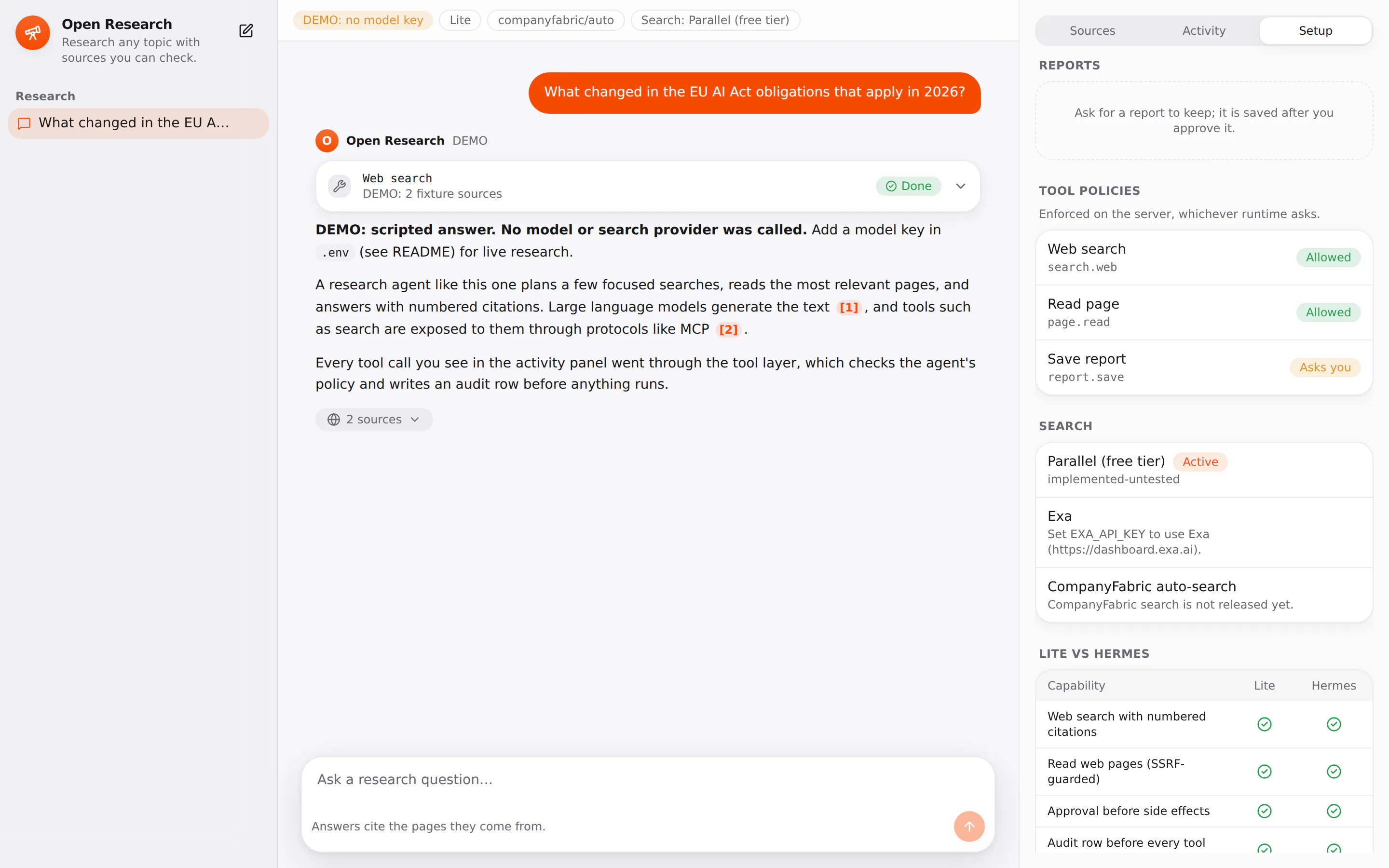
Searching and reading pages run without asking. Saving a report is an approval card with the title and the full text, enforced by the tool layer on the server, whichever runtime asks.
Large language models generate the text 1, and tools such as search are exposed to them through protocols like MCP 2.
Sample data The app's approval card.
Screenshots
Use cases
What a regulation now asks of you, with the clauses cited.
One ask to start with
“What changed in the EU AI Act obligations that apply in 2026?”
Compare tools or frameworks with a source for every claim.
One ask to start with
“Compare the open-source agent frameworks released this year, with sources.”
What the evidence says, and where it is thin.
One ask to start with
“Summarize the current evidence on intermittent fasting and longevity.”
Save a finished answer as a report, after you approve it.
One ask to start with
“Research how teams use the Model Context Protocol and save it as a report.”
Compared
Open Research
Building it yourself
FAQ
Both run from the same app. Lite runs the agent loop in the Next.js server (pnpm dev), and Vercel works. Hermes runs each turn in a Hermes Agent container (v0.22.5, pinned by digest) (docker compose up) and calls the app's tools back over MCP, so policies, approvals and the audit log are the same. Hermes adds memory across threads, and needs a long-running container.
Any OpenAI-compatible chat.completions endpoint with tool calling. The default is CompanyFabric: one key for every major model, billed per token from a prepaid balance, and companyfabric/auto picks a suitable model per request. OpenAI directly, or a local server such as Ollama, LM Studio or vLLM, works too.
OPENAI_BASE_URL=https://api.companyfabric.com/v1
OPENAI_API_KEY=sk-cf-…
MODEL=companyfabric/autoYes. With no model key it runs a DEMO: a scripted turn, clearly labelled, with no model or search call, so you can see the flow. Add a model key for live research.
Yes. It is a Next.js app that keeps its data in one SQLite file: run it on your own machine or server, on Vercel (lite), or with Docker Compose (Hermes). There is no login: the compose file binds the app to 127.0.0.1, so put it behind your own authentication before exposing it.
Parallel's free, rate-limited tier with no key (PARALLEL_API_KEY lifts the limits), or Exa with EXA_API_KEY. A provider that cannot run is shown as unavailable with the reason, never silently replaced. CompanyFabric search is not released yet.
It is early. CI checks every change: Install, typecheck, unit tests and production build; Hermes starts with the app's tools loaded (no model is called in CI). Implemented but not yet run live: Search through Parallel (keyless tier); Search through Exa; Live research eval (10 questions, citation checks); A Hermes turn with a real model.
MIT, © 2026 Creative Tim: read it, change it and ship it. The UI is adapted from AI Elements (Apache-2.0) and shadcn/ui (MIT). Not affiliated with any company whose AI products offer similar research features.
| Capability | Lite | Hermes |
|---|---|---|
| Web search with numbered citations | Yes | Yes |
| Read web pages (SSRF-guarded) | Yes | Yes |
| Approval before side effects | Yes | Yes |
| Audit row before every tool call | Yes | Yes |
| Save reports | Yes | Yes |
| Memory across threadsHermes memory toolset | No | Yes |
| Files and terminal in a sandboxEnable the file / terminal toolsets in hermes/config.yaml | No | Off by default |
| Browser for JavaScript-heavy pagesHermes browser_exec; needs the terminal toolset | No | Off by default |
| Scheduled research (cron)Hermes cron works; this UI does not manage schedules yet | No | Not in the UI yet |
| Runs on serverless hosting (Vercel)Hermes needs a long-running container | Yes | No |
| Variable | Default | What it is |
|---|---|---|
| OPENAI_BASE_URL | https://api.companyfabric.com/v1 | Any OpenAI-compatible chat.completions endpoint with tool calling. |
| OPENAI_API_KEY | none | The model key. With none set, the app runs a labelled DEMO. |
| MODEL | companyfabric/auto | The model id. companyfabric/auto picks a suitable model per request. |
| SEARCH_PROVIDER | parallel | parallel (free, rate-limited, no key) or exa. companyfabric is not released yet. |
| PARALLEL_API_KEY | none | Lifts Parallel's free-tier limits. |
| EXA_API_KEY | none | Needed when SEARCH_PROVIDER=exa. |
| COMPANYFABRIC_SEARCH_ENABLED | false | CompanyFabric search is not released yet; leave it off. |
| RUNTIME | none | lite or hermes. Empty: hermes when HERMES_URL is set, lite otherwise. |
| HERMES_URL | none | Set for you by docker-compose.yml. |
| HERMES_API_KEY | none | Hermes only. Generate with: openssl rand -hex 32 |
| TOOL_TOKEN | none | Hermes only: lets Hermes call the app's tools at /api/mcp. Generate with: openssl rand -hex 32 |
| DATA_DIR | ./data | Where the SQLite database lives. |
Early. Checked in CI on every change: Install, typecheck, unit tests and production build; Hermes starts with the app's tools loaded (no model is called in CI).
Free and MIT. Add a CompanyFabric key for live work: companyfabric/auto picks a suitable model per request, and new accounts get starter credit.
MIT
Open Research is MIT-licensed, © 2026 Creative Tim. Its UI is adapted from AI Elements (Apache-2.0) and shadcn/ui (MIT).
Not affiliated with any company whose AI products offer similar research features.