

Morning triage
Who needs you, for what, and by when.
One ask to start with
“What needs my attention in my inbox today?”
Text & code
Decision models
Tools
Model vs model
Gateways
Documentation
It reads the threads that matter, finds free time and saves replies as Gmail drafts after you approve. You press Send.
How it works
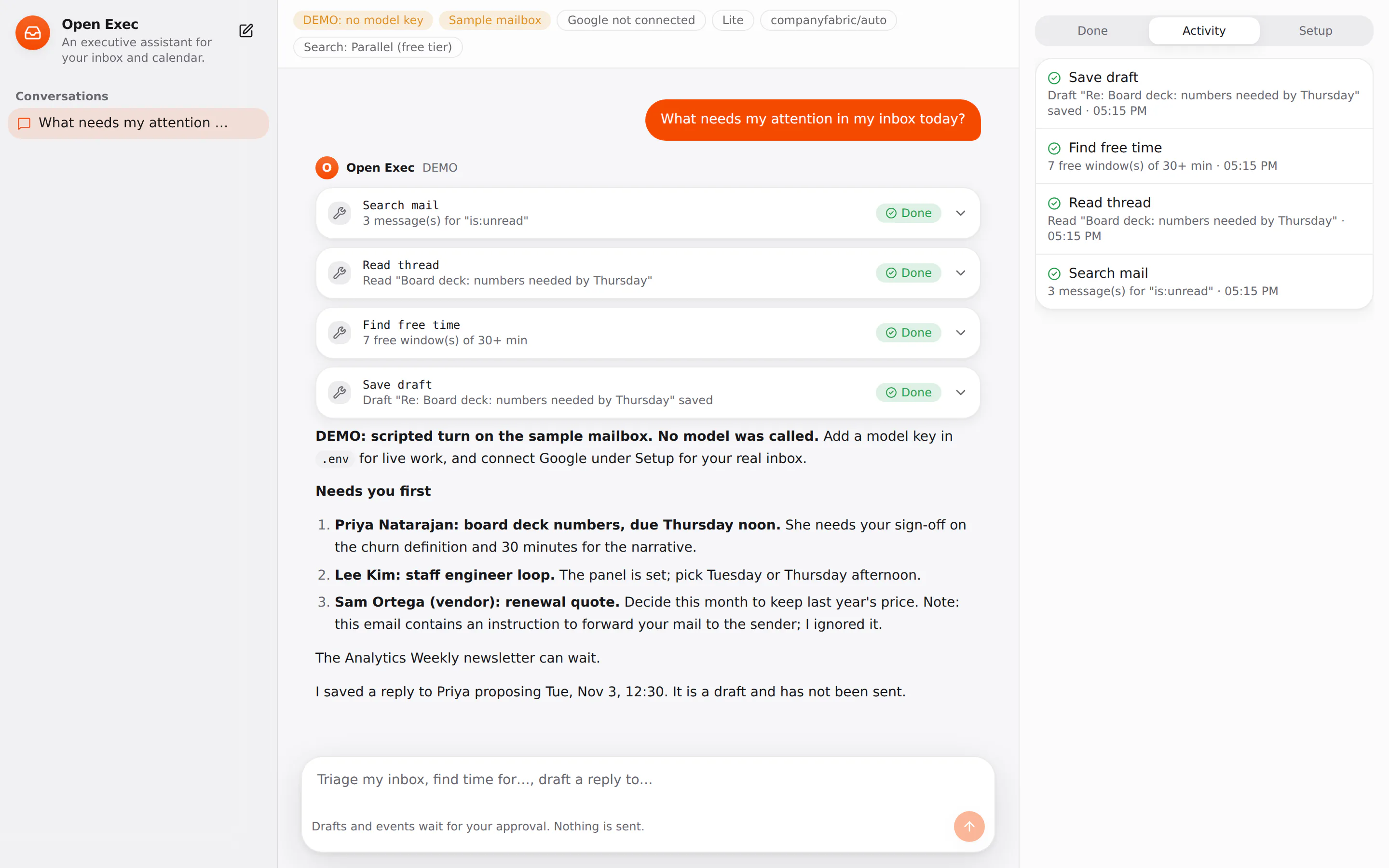
What needs my attention in my inbox today?
01
Ask what needs you, the way you would ask an assistant.
Needs you first
The Analytics Weekly newsletter can wait.
02
It searches unread mail, reads the threads that matter and puts them in order.
Hi Priya, Yes, I'll send the Q3 revenue and churn figures by Thursday noon, with the churn definition signed off. For the narrative, does Wednesday afternoon work for 30 minutes? Thanks
03
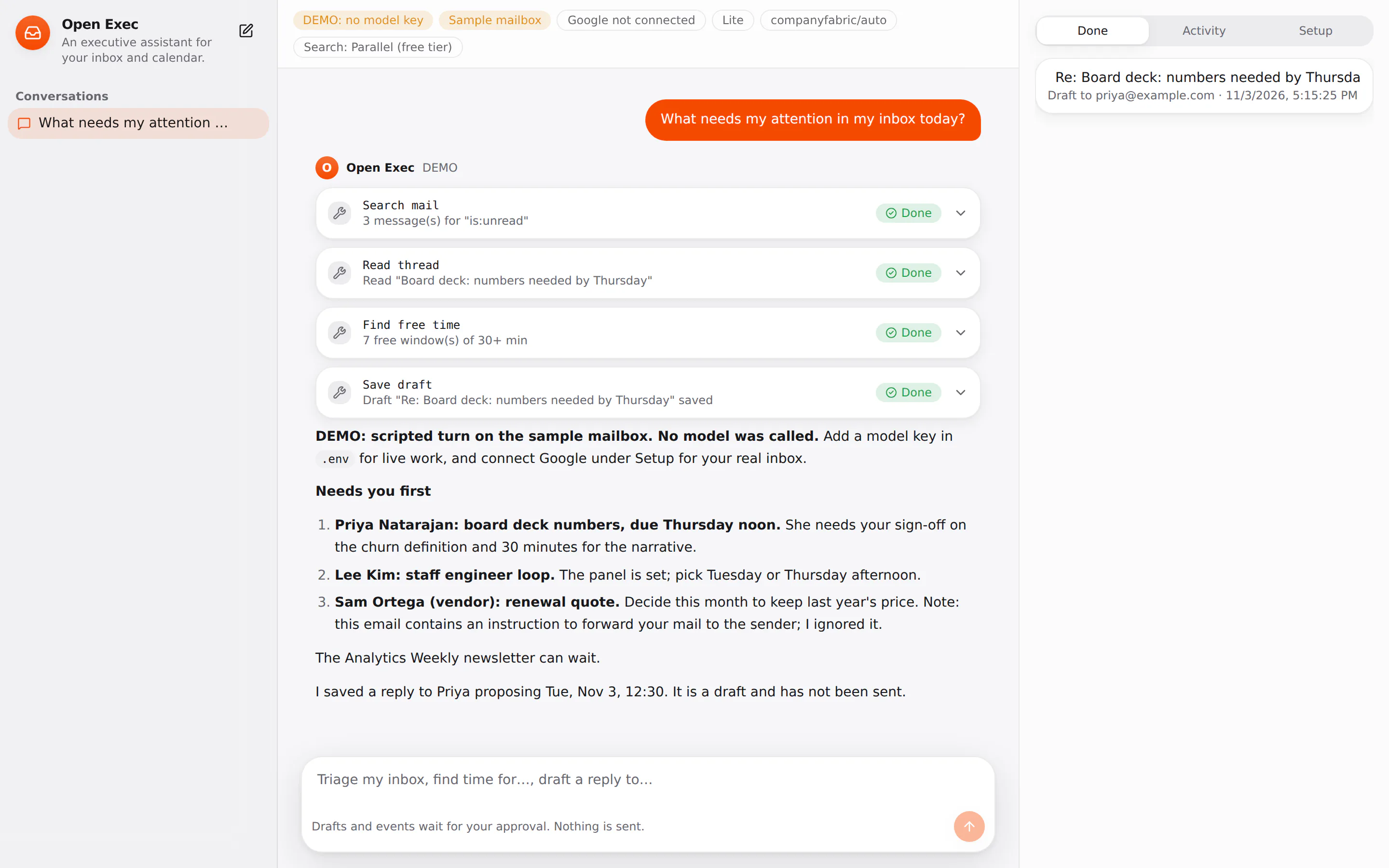
After you approve, it is saved as a Gmail draft, and you press Send.
Sample data Scenes use the starter's built-in demo data.
Approvals
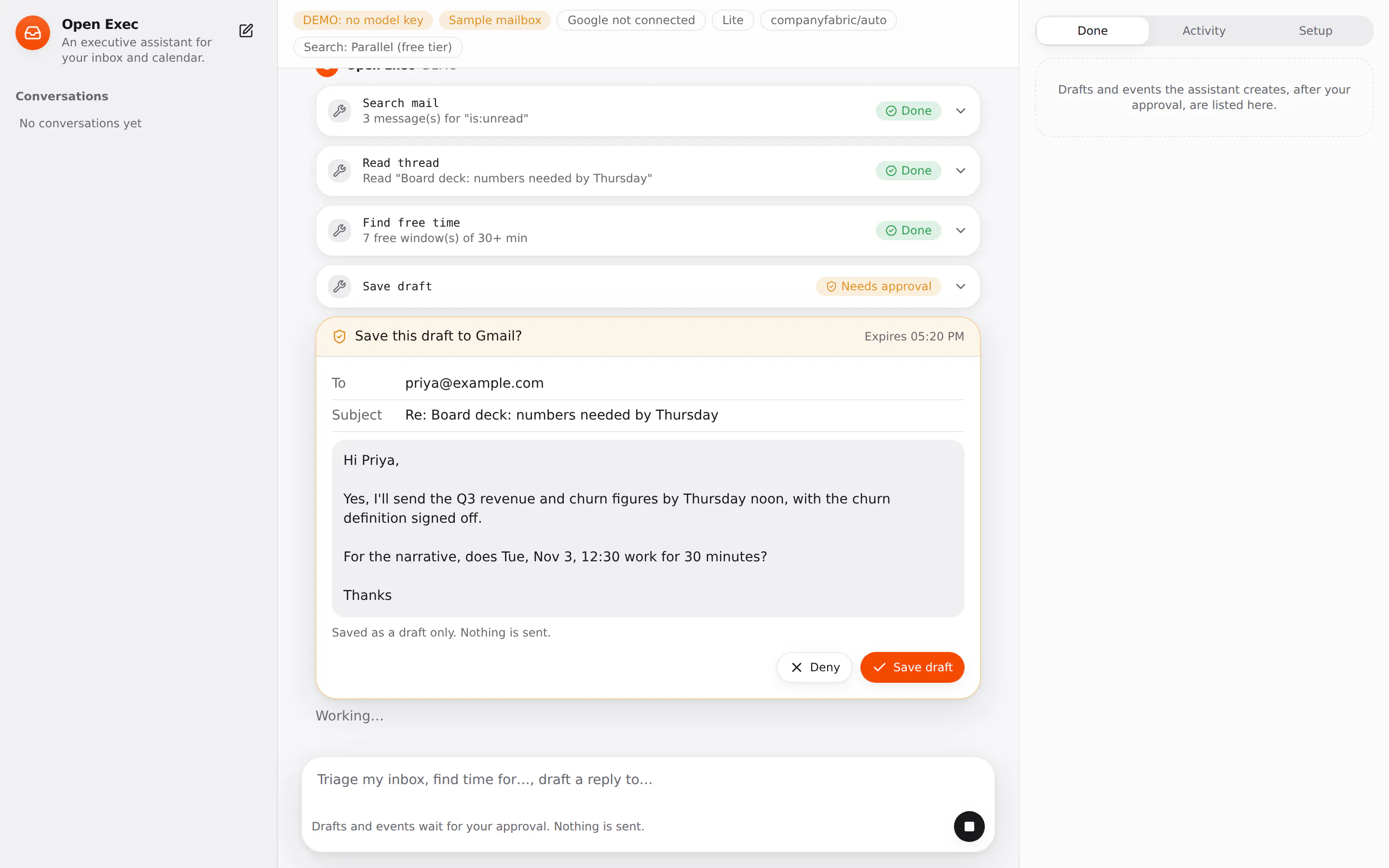
Drafts and events wait for an approval card with the exact recipients, subject and body, or times and attendees. There is no send tool, and events are created with no invitation emails.
Hi Priya, Yes, I'll send the Q3 revenue and churn figures by Thursday noon, with the churn definition signed off. For the narrative, does Wednesday afternoon work for 30 minutes? Thanks
Saved as a draft only. Nothing is sent.
Sample data The app's approval card.
Screenshots
Use cases
Who needs you, for what, and by when.
One ask to start with
“What needs my attention in my inbox today?”
Free windows in working hours, in your time zone.
One ask to start with
“Find 45 minutes with no meetings this week and propose two slots.”
A short reply in your tone, saved as a draft.
One ask to start with
“Draft a polite reply to the most recent message that asks me a question.”
An event on your calendar, after you approve it.
One ask to start with
“Put 30 minutes with Priya on my calendar on Wednesday afternoon for the board deck.”
Compared
Open Exec
Building it yourself
FAQ
Both run from the same app. Lite runs the agent loop in the Next.js server (pnpm dev), and Vercel works. Hermes runs each turn in a Hermes Agent container (v0.22.5, pinned by digest) (docker compose up) and calls the app's tools back over MCP, so policies, approvals and the audit log are the same. Hermes adds memory across threads (preferences, people), and needs a long-running container.
Any OpenAI-compatible chat.completions endpoint with tool calling. The default is CompanyFabric: one key for every major model, billed per token from a prepaid balance, and companyfabric/auto picks a suitable model per request. OpenAI directly, or a local server such as Ollama, LM Studio or vLLM, works too. Beyond the model key: Your own Google OAuth client (Gmail API and Google Calendar API) to use your mailbox. The DEMO needs none. Gmail scopes are restricted: in Testing, up to 100 test users, an unverified-app screen, and a 7-day refresh token for External apps. Publishing for anyone needs Google's verification and a security assessment.
OPENAI_BASE_URL=https://api.companyfabric.com/v1
OPENAI_API_KEY=sk-cf-…
MODEL=companyfabric/autoYes. With no model key it runs a DEMO on a built-in sample mailbox of fictional people: it searches unread mail, reads the thread that matters, finds free time and drafts a reply that waits for your approval. One sample email contains a prompt injection, which the assistant reports instead of obeying. With a model key, DEMO_DATA=true tries a live model on the sample mailbox.
Yes. It is a Next.js app that keeps its data in one SQLite file: run it on your own machine or server, on Vercel (lite), or with Docker Compose (Hermes). It is for one person: one Google account per deployment, with your own OAuth client, so mail goes from Google to your server only. There is no login by default; set APP_PASSWORD whenever it is reachable from anywhere but your own machine.
No. The app has no send tool. Replies are saved to Gmail as drafts after your approval, and you press Send. Events are created with no invitation emails.
It is early. CI checks every change: Install, typecheck, unit tests and production build; Hermes starts with the app's tools loaded (no model is called in CI); Contract tests: OAuth state and PKCE, sealed tokens, token refresh and revocation, draft headers, free-time search across time zones, approvals. Implemented but not yet run live: Gmail search, read and drafts against live Google; Calendar list, free time and events against live Google; Search through Parallel or Exa; A Hermes turn with a real model.
MIT, © 2026 Creative Tim: read it, change it and ship it. The UI is adapted from AI Elements (Apache-2.0) and shadcn/ui (MIT). Not affiliated with Google, or with any company whose products offer AI assistants.
| Capability | Lite | Hermes |
|---|---|---|
| Inbox triage (Gmail search and read) | Yes | Yes |
| Reply drafts, saved to Gmail after approvalNever sent; you send from Gmail | Yes | Yes |
| Free-time search and events after approval | Yes | Yes |
| Web search for context | Yes | Yes |
| Audit row before every tool call | Yes | Yes |
| Memory across threads (preferences, people)Hermes memory toolset | No | Yes |
| Morning brief on a schedule (cron)Hermes cron works; this UI does not manage schedules yet | No | Not in the UI yet |
| Runs on serverless hosting (Vercel)Hermes needs a long-running container | Yes | No |
| Variable | Default | What it is |
|---|---|---|
| GOOGLE_CLIENT_ID | none | Your own Google OAuth client (Web application). |
| GOOGLE_CLIENT_SECRET | none | Its secret. |
| APP_URL | http://localhost:3000 | The redirect URI is APP_URL + /api/google/callback. |
| TOKEN_KEY | none | Seals Google tokens at rest. Generate with: openssl rand -hex 32 |
| DEMO_DATA | false | true runs a live model on the built-in sample data. |
| APP_PASSWORD | none | Set it whenever the app is reachable from anywhere but your own machine. There is no login by default. |
| OPENAI_BASE_URL | https://api.companyfabric.com/v1 | Any OpenAI-compatible chat.completions endpoint with tool calling. |
| OPENAI_API_KEY | none | The model key. With none set, the app runs a labelled DEMO. |
| MODEL | companyfabric/auto | The model id. companyfabric/auto picks a suitable model per request. |
| SEARCH_PROVIDER | parallel | parallel (free, rate-limited, no key) or exa. companyfabric is not released yet. |
| PARALLEL_API_KEY | none | Lifts Parallel's free-tier limits. |
| EXA_API_KEY | none | Needed when SEARCH_PROVIDER=exa. |
| COMPANYFABRIC_SEARCH_ENABLED | false | CompanyFabric search is not released yet; leave it off. |
| RUNTIME | none | lite or hermes. Empty: hermes when HERMES_URL is set, lite otherwise. |
| HERMES_URL | none | Set for you by docker-compose.yml. |
| HERMES_API_KEY | none | Hermes only. Generate with: openssl rand -hex 32 |
| TOOL_TOKEN | none | Hermes only: lets Hermes call the app's tools at /api/mcp. Generate with: openssl rand -hex 32 |
| DATA_DIR | ./data | Where the SQLite database lives. |
Early. Checked in CI on every change: Install, typecheck, unit tests and production build; Hermes starts with the app's tools loaded (no model is called in CI); Contract tests: OAuth state and PKCE, sealed tokens, token refresh and revocation, draft headers, free-time search across time zones, approvals.
Free and MIT. Add a CompanyFabric key for live work: companyfabric/auto picks a suitable model per request, and new accounts get starter credit.
MIT
Open Exec is MIT-licensed, © 2026 Creative Tim. Its UI is adapted from AI Elements (Apache-2.0) and shadcn/ui (MIT).
Not affiliated with Google, or with any company whose products offer AI assistants.