

Research to brief
Ria gathers the facts, Wes writes the page.
One ask to start with
“Research what changed in the EU AI Act for 2026, save notes, then have Wes write a one-page brief.”
Text & code
Decision models
Tools
Model vs model
Gateways
Documentation
Specialist AI coworkers with their own permissions, a shared workspace with versions, and explicit hand-offs.
How it works
R To Ria, Researcher
Research the Model Context Protocol, save notes, then have Wes write a short newsletter summary.
01
Ask the Researcher in plain words, and say who writes it up.
R Ria saved to the workspace
Research notes (DEMO)
RW Handed off to Wes, Writer
Write a three-sentence summary of the research notes for a newsletter, keeping the citations.
02
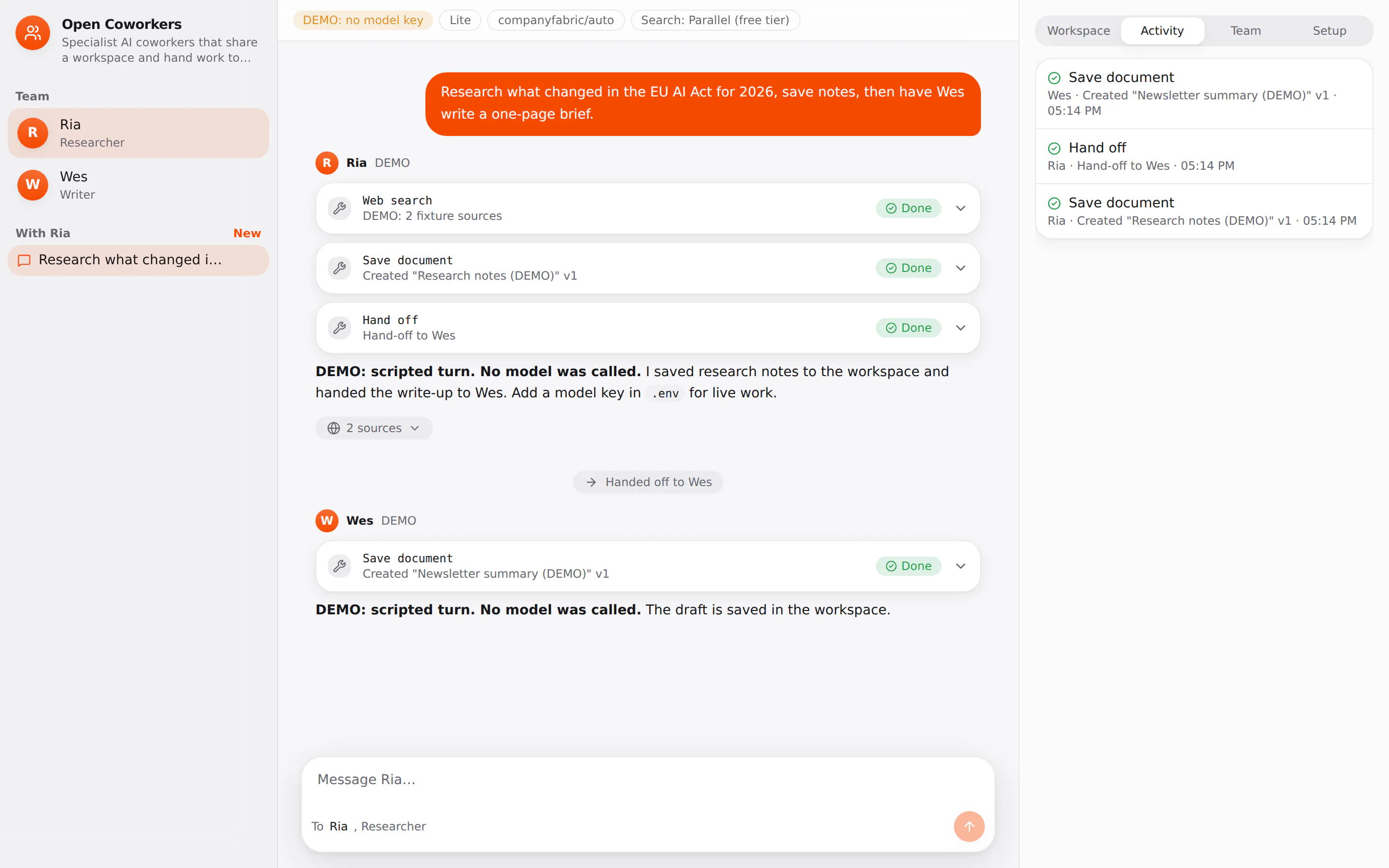
Ria saves cited notes to the workspace and passes the write-up to Wes.
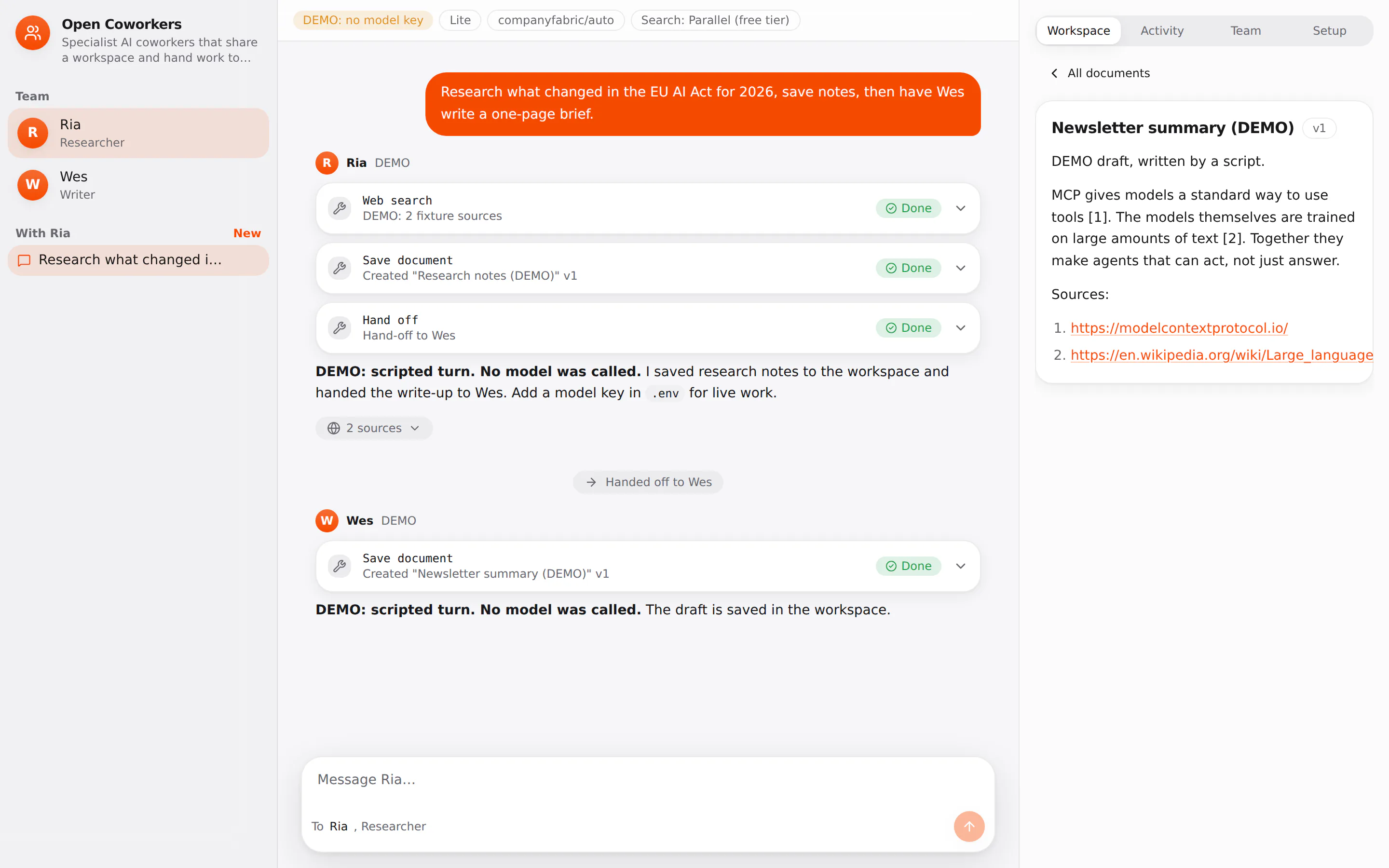
MCP gives models a standard way to use tools 1. The models themselves are trained on large amounts of text 2. Together they make agents that can act, not just answer.
03
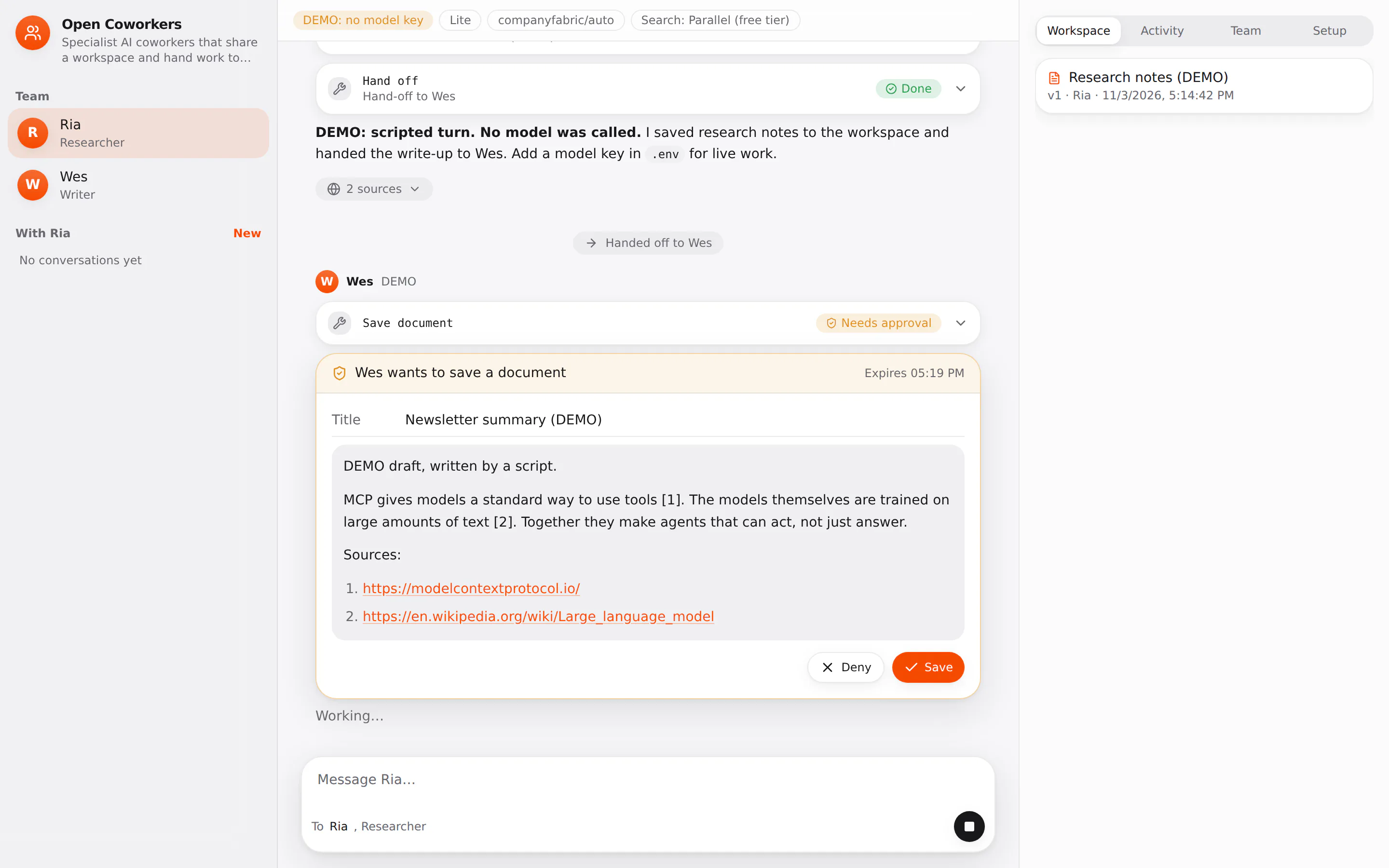
Wes works only from the workspace, and his save waits for you.
Sample data Scenes use the starter's built-in demo data.
Approvals
Ria works on her own. Every document Wes saves waits for your approval, and he cannot search the web: his policy denies it on the server, not a line in his prompt.
Wes, Writer
MCP gives models a standard way to use tools 1. The models themselves are trained on large amounts of text 2. Together they make agents that can act, not just answer.
Sample data The app's approval card.
Screenshots
Use cases
Ria gathers the facts, Wes writes the page.
One ask to start with
“Research what changed in the EU AI Act for 2026, save notes, then have Wes write a one-page brief.”
Credible sources, saved where the team can use them.
One ask to start with
“Find three credible sources on the four-day work week and save them to the workspace.”
Wes turns saved research into a post.
One ask to start with
“Draft a short LinkedIn post from the latest research notes in the workspace.”
Wes hands missing facts back to Ria instead of guessing.
One ask to start with
“Write a one-paragraph update from the research notes, and hand any missing facts back to Ria.”
Compared
Open Coworkers
Building it yourself
FAQ
Both run from the same app. Lite runs the agent loop in the Next.js server (pnpm dev), and Vercel works. Hermes runs each turn in a Hermes Agent container (v0.22.5, pinned by digest) (docker compose up) and calls the app's tools back over MCP, so policies, approvals and the audit log are the same. Hermes adds memory across threads, and needs a long-running container.
Any OpenAI-compatible chat.completions endpoint with tool calling. The default is CompanyFabric: one key for every major model, billed per token from a prepaid balance, and companyfabric/auto picks a suitable model per request. OpenAI directly, or a local server such as Ollama, LM Studio or vLLM, works too.
OPENAI_BASE_URL=https://api.companyfabric.com/v1
OPENAI_API_KEY=sk-cf-…
MODEL=companyfabric/autoYes. With no model key it runs a DEMO: scripted turns, clearly labelled, with no model or search call. The workspace tools, permissions, approvals and hand-offs in it are the real ones, so Ria's notes land in the workspace and Wes's draft waits for your approval.
Yes. It is a Next.js app that keeps its data in one SQLite file: run it on your own machine or server, on Vercel (lite), or with Docker Compose (Hermes). There is no login: the compose file binds the app to 127.0.0.1, so put it behind your own authentication before exposing it.
Yes: add an entry to coworkers.config.ts with a name, role, instructions and a policy per tool. Names, roles and instructions can also be edited in the app's Team tab; tool policies only in code.
It is early. CI checks every change: Install, typecheck, unit tests and production build; Hermes starts with the app's tools loaded (no model is called in CI); Contract tests: permissions per coworker, approvals, workspace versions, hand-offs. Implemented but not yet run live: A live Ria to Wes hand-off with a real model; Search through Parallel or Exa; A Hermes turn with a real model.
MIT, © 2026 Creative Tim: read it, change it and ship it. The UI is adapted from AI Elements (Apache-2.0) and shadcn/ui (MIT). Not affiliated with any company whose products offer AI coworkers.
| Capability | Lite | Hermes |
|---|---|---|
| Specialist coworkers with their own tool permissions | Yes | Yes |
| Shared workspace documents, with versions | Yes | Yes |
| Hand-offs between coworkersQueued: the next coworker starts when the current one finishes | Yes | Yes |
| Approval before side effects | Yes | Yes |
| Audit row before every tool call | Yes | Yes |
| Web search with numbered citations | Yes | Yes |
| Memory across threadsHermes memory is shared by the whole team (one Hermes profile) | No | Yes |
| Files, terminal, browser in a sandboxEnable toolsets in hermes/config.yaml | No | Off by default |
| Recurring responsibilities (cron)Hermes cron works; this UI does not manage schedules yet | No | Not in the UI yet |
| Runs on serverless hosting (Vercel) | Yes | No |
| Variable | Default | What it is |
|---|---|---|
| OPENAI_BASE_URL | https://api.companyfabric.com/v1 | Any OpenAI-compatible chat.completions endpoint with tool calling. |
| OPENAI_API_KEY | none | The model key. With none set, the app runs a labelled DEMO. |
| MODEL | companyfabric/auto | The model id. companyfabric/auto picks a suitable model per request. |
| SEARCH_PROVIDER | parallel | parallel (free, rate-limited, no key) or exa. companyfabric is not released yet. |
| PARALLEL_API_KEY | none | Lifts Parallel's free-tier limits. |
| EXA_API_KEY | none | Needed when SEARCH_PROVIDER=exa. |
| COMPANYFABRIC_SEARCH_ENABLED | false | CompanyFabric search is not released yet; leave it off. |
| RUNTIME | none | lite or hermes. Empty: hermes when HERMES_URL is set, lite otherwise. |
| HERMES_URL | none | Set for you by docker-compose.yml. |
| HERMES_API_KEY | none | Hermes only. Generate with: openssl rand -hex 32 |
| TOOL_TOKEN | none | Hermes only: lets Hermes call the app's tools at /api/mcp. Generate with: openssl rand -hex 32 |
| DATA_DIR | ./data | Where the SQLite database lives. |
Early. Checked in CI on every change: Install, typecheck, unit tests and production build; Hermes starts with the app's tools loaded (no model is called in CI); Contract tests: permissions per coworker, approvals, workspace versions, hand-offs.
Free and MIT. Add a CompanyFabric key for live work: companyfabric/auto picks a suitable model per request, and new accounts get starter credit.
MIT
Open Coworkers is MIT-licensed, © 2026 Creative Tim. Its UI is adapted from AI Elements (Apache-2.0) and shadcn/ui (MIT).
Not affiliated with any company whose products offer AI coworkers.